
For many of us that have worked in a tribal agency or a bureaucracy we know there are challenges within our organization. Just when we a develop a great idea to provide what we think is a much needed service or program or when we try to improve existing programs we then are challenged by some obstacle within the organization. Employees, especially front line workers have to maneuver critically and cautiously if we want to make change and keep our jobs.
The text Community Practice (Hardcastle & Powers, 2004, 99. 262-263), authors suggest that workers must view the agency as the client system and can use the traditional problem solving framework to help move the agency in a different direction.
1. Study the Problem: -learn everything you can about the agency
-how is power exercised and by who
-how are decisions made?
2. Assess what needs to be done
- based on info generated
-develop goals to create change
3. Develop Intervention strategies
-that will change the system
-implement the change
4. Evaluate
-progress or lack of
Since workers are trying to create change within the organization in which they are employed by, the author suggests that workers assess the risk of punitive sanctions and take these into consideration in the planning process (Harcastle & Powers, 2004, p. 263). Workers should not work alone and one method is to use the informal system to identify allies who share the same concerns. It is also important to have connections to sources of power outside of the organization. Identifying allies and reaching out to people in the community that hold power outside of the organization are key components to creating change within a tribal organization. It sometime seems as though you are working backwards. You have to get the support internally and externally with key people before you actually formally present the goal or identified change. This can seem time consuming but it is most important. I have seen employees try to propose change within a program and then receive disciplinary action for proposing the change.
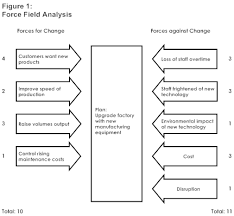
Last week in class we worked in groups on a force field analysis to evaluate and plan for change of a policy. A force field analysis can be used as a strategy to create organizational change. In the analysis you must identify restraining forces and driving forces the goal/problem. This analysis is based from Field Theory. This theory was developed by Kirt Lewin, and states that a group should d be viewed as an entity moving through its immediate environment in the pursuit of its goals and that members constantly adapt to their environments (Kirst-Ashman, 2008). This theory looks at different kinds of forces pursing in the direction of the change (driving forces) and in the direction of resistance to the change (restraining forces) and how these forces maintain balance or imbalances that lead to change (Harcastle & Powers, 2004, pp 264). These forces can be external and internal factors. I have never used a force field analysis in community work. I found it to be a great tool and another method for organizing a plan to create change. I will use it in the future. Here is a link with more information about force field analysis-
http://www.mindtools.com/pages/article/newTED_06.htm


No comments:
Post a Comment