An Indigenous perspective on WAR
On Veterans Day many of us honored the veterans in our life. In my family we have a few Veterans including my non-native grandpa. In the local native community there are many native Veterans who fought for this country. The following link is a story about one of our local Native Vet Archie Thompson http://www.triplicate.com/20091106107418/News/Local-News/A-bridge-to-the-past
This last week I have been thinking about Native Veterans and how it is that so many of our people come to serve in the military. My intent is not to dishonor those that have served but to get those in the community thinking about patriotism and military service. I have always felt that native people should not serve in the military and I have shared this message with my children. I believe that it is ironic to serve for a country that did such horrific things to our people and still continues to fully recognize native sovereignty and continues practicing oppressive and genocidal policies. My children’s great-grandfather once shared with me that he believed that the service was no place for Indian people. He was a veteran of WWII. When he returned home from the war he went into a bar in his uniform and the bar wouldn’t even serve him.
In article entitled, What is the Highest form of patriotism? I say acknowledge our addiction to patriotism, author Prof. Dr. Michael Yellow Bird discusses the lies of patriotism and some concerns he has with the participation of indigenous people in the military (Yellow Bird, in press). The article can be found on his BlogSpot at http://arikaraconsciousness.blogspot.com/ One concern that Dr. Yellow Bird raises is that participating in war violates traditional tribal values/beliefs. He also points out that Indigenous peoples are not just “single-dimensional warrior cultures”, but we are people of peacemakers and negotiators that have a cultural history of working together to settle conflict. I agree, and believe the proof is in our stories and history. In the past one of our cultural practices was to negotiate and settle conflict amongst our own people and neighboring tribes. Yurok people used to operate daily life on a payment system. One way to settle a disagreement or insult is through payment. And as Dr. Yellow Bird points out, tribal nations singed treaties with the United States government to settle war and conflict, although the US has broke or failed to ratify every treaty it made with tribal nations. Other reasons that indigenous peoples join the military include: poverty, a way out, protection of native lands, bravery, and lack of opportunity. I have heard many indigenous people say very similar reasons. The US government nationalism includes a history of genocide and racism. These genocidal practices/policies are still exercised by this country.
Dr. Yellow Bird points out that part of our patriotic nationalism includes the belief that America is the greatest nation and is entitled to the highest standard of living on the planet. I believe that we as a nation will do anything to make sure that we achieve and stand by this ideal. The following is a video clip showing how we are so interested in materialism and how the US has broken a treaty with a sovereign nation to honor individual freedom and capitalism:
Bear Butte
Our patriotism has led us to participate in unnecessary warfare including the occupation of Iraq. We are repeating some of the same practices that that were present in the American Holocaust of Native Americans and the Jewish Holocaust. Dr. Yellow Bird suggests that, “we must end this nations unhealthy attachment to patriotism”. One way to achieve this is to take a moral inventory of patriotic history, documents, slogans and symbols. I agree with his statement, “ This nation must learn to listen, apologize, make amends, and practice humility”.
Here is a video with some interesting points about patriotism and the war-
Another perspective from Russel Means:
Saturday, November 14, 2009


Friday, November 13, 2009
Changing the agency from within

For many of us that have worked in a tribal agency or a bureaucracy we know there are challenges within our organization. Just when we a develop a great idea to provide what we think is a much needed service or program or when we try to improve existing programs we then are challenged by some obstacle within the organization. Employees, especially front line workers have to maneuver critically and cautiously if we want to make change and keep our jobs.
The text Community Practice (Hardcastle & Powers, 2004, 99. 262-263), authors suggest that workers must view the agency as the client system and can use the traditional problem solving framework to help move the agency in a different direction.
1. Study the Problem: -learn everything you can about the agency
-how is power exercised and by who
-how are decisions made?
2. Assess what needs to be done
- based on info generated
-develop goals to create change
3. Develop Intervention strategies
-that will change the system
-implement the change
4. Evaluate
-progress or lack of
Since workers are trying to create change within the organization in which they are employed by, the author suggests that workers assess the risk of punitive sanctions and take these into consideration in the planning process (Harcastle & Powers, 2004, p. 263). Workers should not work alone and one method is to use the informal system to identify allies who share the same concerns. It is also important to have connections to sources of power outside of the organization. Identifying allies and reaching out to people in the community that hold power outside of the organization are key components to creating change within a tribal organization. It sometime seems as though you are working backwards. You have to get the support internally and externally with key people before you actually formally present the goal or identified change. This can seem time consuming but it is most important. I have seen employees try to propose change within a program and then receive disciplinary action for proposing the change.
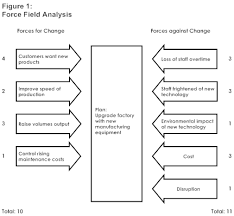
Last week in class we worked in groups on a force field analysis to evaluate and plan for change of a policy. A force field analysis can be used as a strategy to create organizational change. In the analysis you must identify restraining forces and driving forces the goal/problem. This analysis is based from Field Theory. This theory was developed by Kirt Lewin, and states that a group should d be viewed as an entity moving through its immediate environment in the pursuit of its goals and that members constantly adapt to their environments (Kirst-Ashman, 2008). This theory looks at different kinds of forces pursing in the direction of the change (driving forces) and in the direction of resistance to the change (restraining forces) and how these forces maintain balance or imbalances that lead to change (Harcastle & Powers, 2004, pp 264). These forces can be external and internal factors. I have never used a force field analysis in community work. I found it to be a great tool and another method for organizing a plan to create change. I will use it in the future. Here is a link with more information about force field analysis-
http://www.mindtools.com/pages/article/newTED_06.htm
Friday, November 6, 2009
Indian Humor/ Community Assets!

This is way funny! We noticed this coming home one day when we were incredibly tired from all of our commuting.
To throw a social work spin - This is an example of one of our community assets. Our ability to unify as a community This is a cultural intangible asset.
Community connections, Psychic numbing, & Self Disclosure
Last week in class we discussed the use of self in community practice. The chapter and class discussion centered on the importance of critical thinking and the necessary skills to be an effective community practitioner. Some of these essential skills include coordination and advocacy, active listening, counseling, assertiveness and self awareness. Chapter 8 in Community Practice, (Hardcastle & Powers, 2004, pp. 209) points out that community connections are essential to practice. Community work requires that the practitioner have vision of the communal life and the collective good. When working in a tribal community, connections are important when trying to facilitate changes. When I read this section I immediately thought about my role as an intern and how the work I do is very complex and is a huge balancing act. If I don’t practice awareness and critical thinking in the work that I am doing, I could sever my connections in the community which could lead me to not being able to not practice in the community. Interconnectedness is an important cultural value. This awareness includes how you respond to others, awareness of self, personal baggage, personal strengths, belief systems, judgments, examination of power, and public behavior (Hardcastle & Powers, 2004, pp. 209-215). Throughout my last two years of my education and internship I have focused on developing my personal awareness. Higher education and being a helper has allowed me to reexamine my beliefs, judgments, and my personal baggage.
Ann Hartman, the former editor of Social Work, reminds us that we can tune out the community and that we have trained our emotions and minds (Hardcastle & Powers, 2004, pp. 209-210). Her worry is that practitioners will use “psychic numbing to protect ourselves from the pain of seeing what is going on around us”. I agree with Ann and with Prof. Dr. Michael Yellow Bird that we will easily resort to “psychic numbing” with the amount of the world struggles and problems occurring. I see this taking place in my community. For many it is easier to not address or deal with the many social problems that we have as a tribal community. I also understand how community can use “psychic numbing” to protect themselves. For some it is just easier to turn a blind eye to a whole communal problem like alcoholism vs helping one individual with a dui. Tribal communities are dealing with generations of pain and hopelessness resulting from genocide and oppression.
Another important skill that came up in the use of self in community practice, is disclosure. As community workers it is important to think about self disclosure and its purpose in community work (Hardcastle & Powers, 2004, pp. 214). This is the sharing or personal experiences in a professional situation. I believe that self disclosure is necessary and can be beneficial. I think it is important to set limits on personal disclosure. When working in a rural or tribal community it is difficult to not share your personal experiences. Many times community members may already be aware or think that they are aware of your own personal experiences. Sharing personal experiences at the appropriate level and time can aid in developing trust and communication. It is important to know that the worker understands the issues of the community. self disclousre of a similar experience is one way of expressing understanding> From a community perspective, I have appreciated when community workers have self disclosed; it showed that the worker understood the community needs and issues. I agree that are some dangers with self disclosure.
Ann Hartman, the former editor of Social Work, reminds us that we can tune out the community and that we have trained our emotions and minds (Hardcastle & Powers, 2004, pp. 209-210). Her worry is that practitioners will use “psychic numbing to protect ourselves from the pain of seeing what is going on around us”. I agree with Ann and with Prof. Dr. Michael Yellow Bird that we will easily resort to “psychic numbing” with the amount of the world struggles and problems occurring. I see this taking place in my community. For many it is easier to not address or deal with the many social problems that we have as a tribal community. I also understand how community can use “psychic numbing” to protect themselves. For some it is just easier to turn a blind eye to a whole communal problem like alcoholism vs helping one individual with a dui. Tribal communities are dealing with generations of pain and hopelessness resulting from genocide and oppression.
Another important skill that came up in the use of self in community practice, is disclosure. As community workers it is important to think about self disclosure and its purpose in community work (Hardcastle & Powers, 2004, pp. 214). This is the sharing or personal experiences in a professional situation. I believe that self disclosure is necessary and can be beneficial. I think it is important to set limits on personal disclosure. When working in a rural or tribal community it is difficult to not share your personal experiences. Many times community members may already be aware or think that they are aware of your own personal experiences. Sharing personal experiences at the appropriate level and time can aid in developing trust and communication. It is important to know that the worker understands the issues of the community. self disclousre of a similar experience is one way of expressing understanding> From a community perspective, I have appreciated when community workers have self disclosed; it showed that the worker understood the community needs and issues. I agree that are some dangers with self disclosure.
Subscribe to:
Comments (Atom)

